


ข่าวอุตสาหกรรม
 บ้าน / ข่าว / ข่าวอุตสาหกรรม / Electrofusion vs Butt Fusion: Choosing the Right HDPE Joining Method for Your Project
Electrofusion vs Butt Fusion: Choosing the Right HDPE Joining Method for Your Project
 2026.11.17
 ข่าวอุตสาหกรรม
Electrofusion vs Butt Fusion: The Verdict Before the Detail
Electrofusion wins when the pipe cannot move, when the trench is tight, when the diameter sits between 20 mm and 250 mm, or when the joint must be welded, logged and left alone without a heating plate exposed to weather. Butt fusion wins when the pipe can be strung out on the surface, when diameters climb above roughly 250 mm, and when several hundred joints on one project make a cheaper fitting worth a heavier machine and a more disciplined crew. A 315 mm water main laid across open ground is butt fusion work. A 90 mm gas service repair inside a 700 mm trench is electrofusion work. Most arguments about the two methods come from applying one of those answers to the other job.
| Decision factor | Electrofusion | Butt fusion |
|---|---|---|
| Common outside diameter range | 20 mm to 400 mm, with some sizes up to 630 mm | 63 mm to 1600 mm, large machines up to 2000 mm |
| Pipe movement during welding | None; the fitting clamps and pressurises itself | The machine pulls, aligns and holds both pipe ends |
| Trench working space | Roughly pipe diameter plus a hand's width for cables | Machine frame, planing tool travel and plate clearance |
| Machine capital cost | Low to medium; one control unit covers many sizes | Medium to high; inserts, planing tool and heating plate per size band |
| Fitting cost per joint | Higher; heating wire and terminals are moulded in | Lower; the fitting is a plain moulded or machined part |
| Operator influence on the weld | Lower; the cycle comes from the fitting barcode | Higher; facing, alignment and changeover are manual skills |
| Weather exposure of the melt | Moderate; the joint is enclosed, but the pipe must be dry | High; the open melt faces wind, dust and rain |
| Weld record | Control unit logs voltage, time, ambient temperature and joint ID | Manual or semi-automatic log of pressures, times and plate temperature |
| Typical best fit | Repairs, tie-ins, valves, small and medium diameters, tight trenches | Long runs, large diameters, open ground, high joint counts |
Choose electrofusion when
- The pipe run cannot be pushed, pulled or lifted to load a butt fusion machine
- The joint is a repair, tie-in, valve connection or a branch made with a tapping saddle
- The trench is narrow, deep, shored, or crowded with other services
- The outside diameter is under about 250 mm and joint count on the project is high
- The client wants a recorded weld with time, voltage and operator identification
- A steel-to-PE transition has to be made inside a single fitting
Choose butt fusion when
- The pipe can be laid out straight beside the trench and lowered in after welding
- Diameters run 250 mm and above, where electrofusion fittings become expensive and slow
- Wall thicknesses are heavy, from SDR 7.4 to SDR 17, and a full-section weld is required
- Hundreds of similar joints justify a hydraulic machine and a trained crew
- Large tees, wyes and stub ends are fabricated from pipe stock on site
- The line crosses open ground, a river, a mining area or an industrial estate
Most large projects use both. A common split is butt fusion for the main run of 315 mm to 630 mm pipe, electrofusion for the tie-ins where the new main meets the existing network, and electrofusion again for every repair and every valve connection that cannot be moved. Treating the two methods as competitors on the whole project is usually a mistake; treating them as tools with different footprints is what keeps the programme moving.
How Each Method Physically Forms a Joint
Both methods melt polyethylene and let it cool under pressure. The difference is where the heat comes from and what supplies the pressure, and that difference explains almost every practical rule that follows.
Electrofusion: heat generated inside the fitting
An electrofusion coupler, elbow or tee carries a heating wire moulded just under its inner surface. The control unit reads the barcode on the fitting, applies a defined voltage for a defined time, and the wire heats the polymer at the interface with the pipe wall. The melt expands, but the cold outer body of the fitting and the pipe itself confine it, so pressure builds at the joint face without any external force. The fitting effectively clamps, heats, pressurises and cools the joint on its own.
What the operator controls is everything before and after that cycle: scraping the pipe to remove the oxidised layer, marking the insertion depth, keeping the surface dry and grease free, checking that the pipe is round, and leaving the joint undisturbed until the cooling time has passed. A perfect weld cycle on a badly scraped pipe still produces a joint that will peel apart, which is why the scraper matters more than the control unit.
Butt fusion: heat applied from outside, pressure from the machine
Two faced pipe ends are clamped in the machine, brought together to check alignment, then held against a heated plate at roughly 200 °C to 220 °C. The plate is removed, the ends are brought together within a defined changeover time, and the machine holds the joint under pressure while a bead rolls out on both the outside and the inside of the pipe. Heating, changeover, joining and cooling times are calculated from wall thickness and pressure regime in the governing standard, which is why a 400 mm SDR 17 joint takes far longer than a 110 mm SDR 11 joint of similar length. The machine supplies alignment, force and the cooling hold; the crew supplies the discipline.
| Process variable | Electrofusion control | Butt fusion control |
|---|---|---|
| End preparation | Scrape the full circumference to insertion depth, remove oxide layer | Face both ends square, remove chips, check ovality |
| Alignment | Pipe enters the fitting straight, insertion marks visible at both ends | High and low misalignment kept inside standard limits |
| Heat source | Heating wire inside the fitting, parameters from the barcode | Heating plate, temperature verified with an independent gauge |
| Pressure source | Expansion of melt inside a confined sleeve | Hydraulic or manual force from the machine |
| Contamination risk | Dust, water or soil on the freshly scraped surface | Wind-blown dust on the open melt, contaminated plate face |
| Cooling | No movement and no water until the cooling time is complete | Held in the machine under pressure until the cooling time is complete |
| Records | Control unit log of voltage, time and ambient temperature | Operator log of pressure, time, plate temperature and joint number |
 HDPE Electrofusion Equal Coupler for Pipe JointsA corrosion- and pressure-resistant HDPE coupler for electrofusion joints, suited to smaller-diameter water, drainage and chemical pipelines where quick, economical connections are needed.View Product →
Diameter, Wall Thickness and Trench Access
Diameter decides more projects than any technical argument. Electrofusion fittings are economical and quick from 20 mm up to about 250 mm; above 315 mm the fitting price rises sharply and the cooling time becomes a scheduling problem rather than a technical one. Butt fusion starts to make sense from about 110 mm and becomes the default from 250 mm to 1600 mm. Below 63 mm, socket fusion or electrofusion is normally used, because a butt fusion machine cannot grip and align small pipe reliably.
| Outside diameter band | Usual method | Reason |
|---|---|---|
| 20 mm to 63 mm | Electrofusion or socket fusion | Butt fusion machines are rarely available or accurate at this size |
| 75 mm to 160 mm | Electrofusion, with butt fusion viable | Urban services and tight trenches favour the compact fitting |
| 180 mm to 315 mm | Both competitive | Access, joint count and client specification decide |
| 355 mm to 630 mm | Butt fusion default, electrofusion for repairs | Fitting cost and cooling time rise steeply at the top of the band |
| 710 mm to 1600 mm | Butt fusion only in practice | Electrofusion fittings are rarely produced at this scale |
Wall thickness changes the arithmetic again. A SDR 17 pipe with a modest wall heats and cools quickly on a butt fusion machine, while a SDR 7.4 pipe of the same outside diameter takes far longer in both the heating and the cooling phase. Electrofusion cycles are set by the fitting and the ambient temperature rather than by the pipe wall, but the cooling time still grows with size, and a 315 mm coupling can occupy a joint for the better part of an hour before it can be handled or pressure tested.
Access is the factor that site engineers underestimate most often. A butt fusion machine needs room for the frame, the travel of the planing tool, the height of the heating plate and the space to lift the pipe into the clamps. A physically shored trench with 400 mm of clear working space on each side of the pipe will not accommodate that. An electrofusion control unit, a cable and two hands need far less, and the fitting stays on the pipe rather than the pipe staying in a machine.
Equipment, Power and Site Logistics
What a butt fusion spread needs
- A machine frame sized to the outside diameter, with inserts for each size in the programme
- A planing tool with sharp blades, and a spare set for heavy project volumes
- A heating plate with an independent thermometer and a clean, undamaged coating
- A hydraulic pump or manual pump rated for the joining pressure required by the wall thickness
- A generator sized for the pump and plate, plus lifting gear, pipe rollers and shelters
Pressure calculation is where inexperienced crews lose joints. The joining pressure depends on the pipe wall thickness and the effective cylinder area of that specific machine, so a pressure table from a different machine cannot be copied across. Modern machines often display the required gauge pressure once the size and SDR are entered, and that value should be verified against the manufacturer's chart before production welding begins.
What an electrofusion spread needs
- A control unit with barcode scanning, ambient temperature compensation and data download
- Welding cables in good condition, checked for length limits and terminal corrosion
- A generator or supply with enough capacity for the peak current of the largest fitting
- A hand scraper or mechanical scraper matched to the pipe diameter
- An external clamp for larger sizes, a clean marker for insertion depth, and a work tent
Electrofusion units draw high current at low voltage, and long cables create voltage drop that the unit cannot fully compensate for. A generator that starts a butt fusion machine without trouble may still be marginal for a large coupling, especially when several joints run back to back. On remote sites, the supply should be sized from the fitting programme rather than from a single joint, and the control unit should be checked for voltage tolerance before the first weld of the day.
 Butt Fusion Welding Machine for PE, PP and PVCAutomated butt fusion machine with induction heating and no filler material, suitable for PE, PP and PVC pipe joints where power and installed cost matter.View Product →
The Cost Model Behind the Choice
Fitting price is the number people quote, but it is rarely the number that decides. Installed cost per joint has four parts: the fitting or consumable, the machine capital written off over the project, the labour for set-up, welding and cooling, and the rework or inspection cost. Electrofusion puts cost into the fitting and takes it out of the machine and the labour. Butt fusion reverses that balance, which is why the break-even point moves with joint count rather than with pipe size alone.
Where electrofusion costs more
The coupling itself carries the heating wire, terminals and moulding complexity, so a 250 mm electrofusion coupler can cost several times a plain butt fusion coupler. Cooling time also holds a crew in place on larger sizes.
Where butt fusion costs more
The machine, inserts, planing tool and heating plate are a capital item, and each size band needs its own set. Set-up time per joint is longer, and the crew must be trained and certified to a higher level.
The rework factor
A failed electrofusion joint usually means cutting out a fitting. A failed butt fusion joint means cutting out a section of pipe and possibly losing a whole string welded the same day with the same faulty plate.
Illustrative installed cost per joint, indexed to a 250 mm butt fusion joint as 100
Butt fusion 110 mm
Electrofusion 110 mm
Butt fusion 250 mm
Electrofusion 250 mm
Butt fusion 400 mm
Electrofusion 400 mm
Index built from fitting price, machine write-off, crew time and inspection. Real quotations vary widely with country, currency and project volume; use this only to see the shape of the curve.
The curve is the practical message. At 110 mm the gap between the methods is modest and is easily closed by access difficulties, because a machine that cannot reach the joint has infinite cost. At 400 mm the gap is large enough that electrofusion is normally reserved for repairs, tie-ins and the joints a machine physically cannot reach. On a project with 40 joints of 160 mm, the fitting premium for electrofusion may be smaller than buying or renting a machine plus inserts. On a project with 400 joints of 250 mm, the fitting premium usually exceeds the machine cost and the labour saving has to be argued carefully.
Joint Quality, Inspection and Failure Patterns
Both methods produce joints that approach the strength of the parent pipe when the parameters are correct, and both fail in predictable ways when they are not. The failure patterns are different enough that the inspection routine has to change with the method, which is often the real reason a specification names one process and excludes the other.
| Defect | Method | Usual cause | Prevention |
|---|---|---|---|
| Cold weld or lack of fusion | Butt fusion | Plate too cold, soak time too short, slow changeover | Calibrated plate, timer, two-person changeover drill |
| High-low misalignment | Butt fusion | Clamps not adjusted, oval pipe forced into the machine | Check alignment dry before heating, re-round in the clamps |
| Voids at the interface | Electrofusion | Moisture or soil on the scraped surface | Scrape immediately before assembly, keep the surface covered |
| No weld or short circuit | Electrofusion | Wrong fitting size, damaged coil, unstable supply | Match OD and SDR, scan the barcode, check voltage |
| Pipe pulled out during cooling | Electrofusion | Insertion mark ignored, pipe in tension | Mark depth, support the pipe, hold until cool |
| Oversized or uneven bead | Butt fusion | Excess joining pressure, wrong plate temperature | Follow the pressure regime, measure the bead against the chart |
| Slow crack growth in service | Both | Contamination, poor cooling, water quenching | Full cooling time, no forced cooling, clean environment |
Butt fusion inspection starts with the bead. A correct joint shows a double bead on both sides of the weld, uniform in height, with no offset between the pipe ends and no visible inclusions. The standard gives bead dimensions for each wall thickness, and a bead outside that range is a signal to cut out the joint rather than to defend it. Electrofusion inspection is different: many fittings carry a fusion indicator that rises when the correct pressure and temperature have been reached, but the indicator does not prove the surface was scraped.
For critical lines, destructive testing of sample joints made in the same conditions is the only way to prove that the procedure, the machine and the crew are all working together. Ultrasonic inspection is available for butt fusion welds and is used on gas and large diameter water work, while hydrostatic pressure testing remains the final acceptance test for the completed line, performed only after every joint has completed its full cooling time.
Weather, Environment and Everyday Site Conditions
Weather affects the two methods in different places, and understanding where the joint is exposed tells you which shelter to build.
Cold weather
Below about 5 °C, polyethylene becomes stiffer and the melt cools faster. Many electrofusion units accept an ambient temperature input and adjust the cycle, while butt fusion needs longer heating and additional plate protection. Preheating the pipe ends is standard practice for socket fusion in cold conditions and is worth considering for electrofusion as well.
Heat and direct sun
Pipe laid in full sun can expand enough to push a freshly made joint out of alignment. Electrofusion joints are particularly vulnerable because the fitting does not clamp the pipe against axial movement. Shade the pipe, or leave the insertion marks visible and check them after cooling.
Wind and dust
Butt fusion exposes molten polymer to the air during changeover. Wind-blown sand and dust land on the melt and become inclusions. A tent or windbreak around the machine is not optional on exposed sites, and plates should be kept covered between joints.
Rain and humidity
Water at the electrofusion interface turns to steam and creates voids inside the weld. A wet pipe must be dried and re-scraped, not wiped and welded. Butt fusion tolerates damp ground better, but rain on the heating plate destroys the coating and changes the heat transfer.
The general rule is simple. Electrofusion protects the melt but not the surface, so the discipline is in preparation. Butt fusion protects nothing, so the discipline is in the shelter, the plate and the changeover timing. A crew that builds a proper tent and keeps the plate clean will produce better butt fusion joints than a crew with a newer machine and no shelter.
Matching the Method to the Application
Application decides more specifications than price. Gas networks, potable water utilities and industrial plants each carry their own standards, and those standards often name the acceptable joining methods before the contractor has any say.
| Application | Preferred method | Why |
|---|---|---|
| Potable water transmission mains | Butt fusion from 250 mm | Long runs, large diameter, low cost per joint, full-section weld |
| Urban distribution and service connections | Electrofusion | Tight trenches, short lengths, frequent tees and transitions |
| Gas distribution | Electrofusion, butt fusion on steel-size mains | Recorded weld data, repair capability, tight working space |
| Mining slurry and tailings lines | Butt fusion | Large diameter, heavy wall, high wear allowance, site fabrication |
| Landfill leachate and gas collection | Both | Butt fusion for headers, electrofusion for laterals and repairs |
| Irrigation and agriculture | Electrofusion or socket fusion | Small diameters, low pressure, minimal equipment on site |
| Building drainage and siphonic roof systems | Electrofusion | Confined ceiling voids, branch fittings, fire-rated penetrations |
| Floating cages and wave breakers | Butt fusion plus mechanical brackets | Large frame pipes welded on shore, brackets bolted or clamped |
| PE-RT II heating and process lines | Electrofusion or butt fusion by size | Small bore favouring fittings, larger headers welded on site |
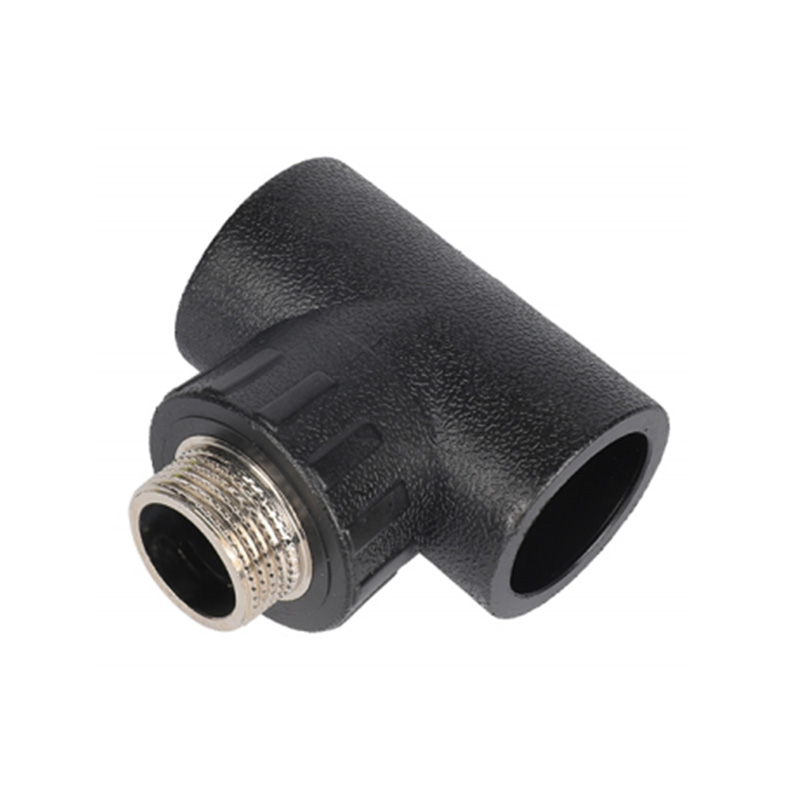
Where the line changes direction, reduces or branches, the fitting programme matters as much as the welding method. A butt fusion tee at 400 mm is often fabricated from pipe and welded on site, while a 110 mm electrofusion tee arrives as a single injection-moulded part with the coil already inside. The choice of method therefore also determines whether the fittings can be delivered complete or have to be built by the crew.
 HDPE Butt Fusion Equal Tee for Branch ConnectionsA corrosion- and pressure-resistant HDPE equal tee for hot-melt butt fusion branch connections, available in dn 63–630 mm with SDR17, SDR13.6 and SDR11 options.View Product →
Material Grade, SDR and Fitting Availability
Welding parameters belong to the material as much as to the method. PE100 and the newer PE100-RC grades are the standard for buried water and gas lines, PE80 still appears on older networks and repair stock, and PE-RT II is used for higher temperature heating and process duties. A fitting has to match the pipe in outside diameter, SDR and material grade, because a mismatch in wall thicknesses leaves a step at the interface that no cycle can correct.
A butt fusion coupler, reducer or tee can be machined from the same PE100 stock as the pipe, which means a fabricator can supply a size that no mould exists for. An electrofusion fitting cannot be improvised in the same way: the coil geometry, the terminal positions and the barcode parameters are fixed at the mould. That difference explains why unusual large sizes, one-off tees and transition pieces are normally butt fusion items, while standard sizes from 20 mm to 315 mm are normally electrofusion items.
Availability also shapes the plan. A project that mixes both methods needs both fitting ranges on site, plus the right transition fittings where PE meets steel, brass or a valve. Tapping saddles, electrofusion reducers, PE-to-steel adapters and stop valves all sit in the electrofusion family, while stub ends, backing rings and flange adaptors are usually butt fusion parts. Ordering both families against the same programme avoids the situation where the main run is complete and the last three connections wait six weeks for a coupling. Details of the ranges produced in our own works, including the fitted and welded product families, are set out on the company profile page.
Crew Competency and Weld Traceability
Electrofusion is often described as the method that removes operator skill from the equation. That is only half true. The cycle is controlled, but the preparation is not, and a badly scraped pipe fails just as reliably as a badly heated one. What electrofusion genuinely reduces is the variance between operators: two trained technicians using the same unit and the same scraper should produce joints that differ very little.
Butt fusion is more sensitive to technique. Facing, alignment, plate temperature, changeover speed and pressure all sit with the crew, and a single habit carried across a whole shift can affect dozens of joints before anyone notices. Operator qualification to a recognised scheme, with periodic re-testing, is the only reliable control. The written procedure matters less than whether the crew actually follows it when the trench is wet and the programme is late.
Traceability is where the two methods separate for asset owners. A modern electrofusion unit records joint number, time, voltage, ambient temperature and sometimes GPS position, and that file can be handed over as part of the as-built pack. Butt fusion records are usually manual, and their quality depends on how seriously the supervisor treats the log sheet. For pipelines that will be mapped and maintained for fifty years, a digital weld record per joint is a real operational asset, not paperwork. Where a full welding procedure still needs to be built from scratch, our guide to welding HDPE pipe covers the step-by-step sequence in more detail.
A Practical Checklist Before You Commit
- Confirm the diameter range, wall thickness and material grade of every joint on the drawing, not just the main run.
- Walk the trench and measure the clear working space at the tightest three points.
- Count the joints and separate them into open-ground, tie-in and repair categories.
- Check whether the client specification or utility standard names an approved joining method.
- Price the fittings for both methods at the actual sizes and quantities involved.
- Add machine capital, inserts and generator capacity to the butt fusion side of the comparison.
- Confirm the training and certification status of the crew that will actually make the joints.
- Decide how weld records will be captured and handed over, then check the equipment supports it.
- Plan shelters, tents and windbreaks before the first shift rather than after the first failed test.
- Agree the inspection and pressure test sequence, including the cooling time that must be respected before testing.
Frequently Asked Questions
Can electrofusion be used on a wet pipe?
No. Water at the interface turns to steam during the cycle and leaves voids inside the weld, which can pass a short pressure test and fail months later. Dry the pipe, then re-scrape the surface before assembling. Wiping a wet pipe and welding it is one of the most common causes of peel failures on site.
Is butt fusion stronger than electrofusion?
Both methods can produce joints that approach the strength of the parent pipe when the parameters and preparation are correct. The difference is process control rather than peak strength. Electrofusion joints are less sensitive to crew technique during the weld cycle, while butt fusion joints are less sensitive to surface moisture and contamination because the melt is generated fresh at the interface.
What is the smallest diameter for butt fusion?
Most machines from reputable makers start at 63 mm, with some light workshop models reaching 50 mm. Below that, alignment and clamping become unreliable, and socket fusion or electrofusion is the practical choice. Above 63 mm, the machine class and insert set determine the range.
How long before a joint can be pressure tested?
The full cooling time in the applicable standard must be respected. For large butt fusion joints this can run into hours, and for large electrofusion couplings the cooling phase alone can take the better part of an hour. Pressure testing a joint that is still cooling can move the interface and create a defect that was not there at the end of the weld.
Can electrofusion join two different pipe sizes?
Yes, through electrofusion reducers and reducing tees, which are made as single fittings with the coil spanning the transition. Butt fusion also handles size changes through reducing inserts or dedicated reducers. The limit is the wall thickness difference at the interface, not the outside diameter alone.
Do I need a generator for electrofusion welding?
Usually yes on site, because the peak current of a large fitting can exceed what a small site supply will deliver. The unit should be sized from the largest fitting in the programme and from the length of cable run, and the supply should be checked for voltage stability before the first joint of the day.
What ambient temperatures are acceptable?
Most electrofusion control units state a working range of roughly minus 5 °C to plus 45 °C, with cycle adjustment for ambient temperature. Outside that range, additional measures are needed. Butt fusion can be carried out in colder conditions with longer heating times and proper shelter, but the plate and the pipe ends must be protected from wind and snow.
Can PE-RT II be joined by both methods?
Yes. PE-RT II pipe is joined with matching electrofusion and butt fusion fittings, with parameters set by the material rather than by the method. Mixing PE100 and PE-RT II fittings on the same joint is not acceptable, because the melt behaviour and the pressure rating differ.
How many joints can a crew complete in a day?
On 110 mm electrofusion work, a well-organised two-person team can complete several dozen joints in a shift, limited mainly by scraping and cooling. On 250 mm butt fusion work, ten to twenty joints a day is a realistic production rate once set-up, facing and cooling are counted honestly. Doubling a crew does not double output unless the machine, the shelter and the pipe handling are planned around it.
Which method is cheaper for one kilometre of 200 mm pipe?
It depends on access and joint count rather than on diameter alone. For a straight run in open ground with roughly 90 joints, butt fusion usually comes out cheaper once the machine is amortised across the project. For a run through a town with short lengths, many tie-ins and a narrow trench, electrofusion often wins even though the fittings cost more, because the alternative is a machine that cannot be positioned.
Can I mix the two methods on one pipeline?
Yes, and most projects do. The main run is welded by butt fusion, and the tie-ins, valve connections and repairs use electrofusion fittings. What must stay consistent is the material grade, the SDR and the pressure rating across the whole line, and the inspection records need to identify which method produced each joint.




ให้อยู่ในการติดต่อ

เกี่ยวกับเรา
Zhejiang Fengfeng Pipe Industry Co., Ltd. ใช้การฉีดสกรูเดี่ยวที่มีประสิทธิภาพ เครื่องปั้นสำหรับสูง ผลผลิตและการใช้พลังงานต่ำ
ลิงค์สินค้า
ติดต่อ
-

+86-19858193396
+86-13735359894 -

+86-0574-63555288
-

อีเมล์: [email protected] -

เลขที่ 21 ถนนตลาด เมืองเตี้ยนโข่ว เมืองจูจี้ เมืองเส้าซิง มณฑลเจ้อเจียง จีน

ลิขสิทธิ์ © Zhejiang Fengfeng Pipe Industry Co., Ltd.
